
Out in the chicken coop, just beyond reach of the back porch light, the white leghorn rooster yells into the gloom of a late winter predawn. Somewhere in the naked hardwoods surrounding our little home, a barred owl asks: “Who cooks for you, who cooks for you all?”
I am cooking for me. I’m cooking for Christine and granddaughter Lenny, too.
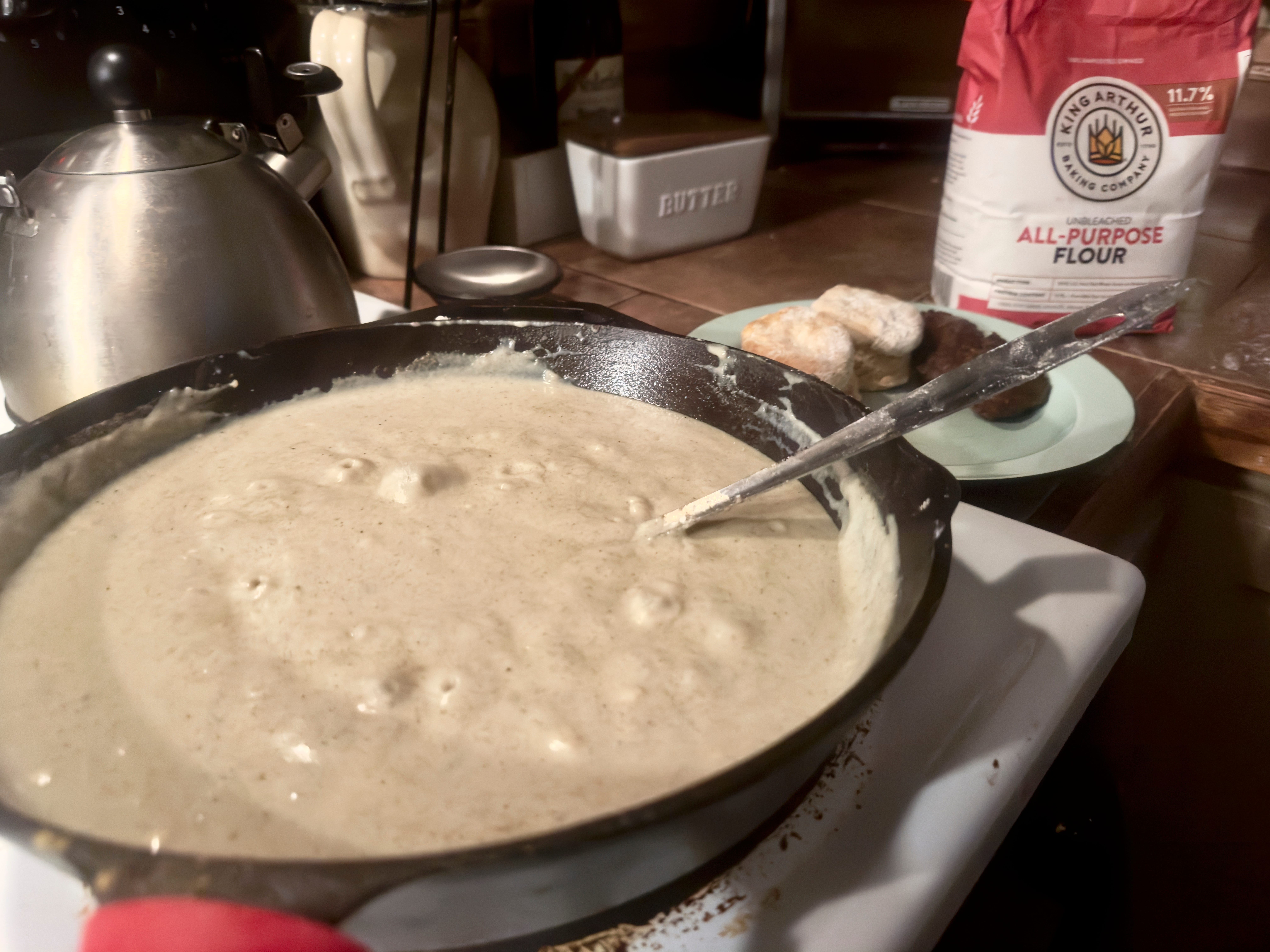
In the dimly lit kitchen, a cast-iron skillet sits on the burner of a cheap electric range. An earthy, milky sweetness mingles with aromas of spicy sausage and mellow, buttery biscuits. I stir the simmering, bone-colored contents of the skillet with one hand. I lift a mug and sip room-temperature coffee with the other.
Italian Americans have tomato sauce, Mexican Americans have mole, Cajuns have dark roux, and Black Americans have barbecue sauces. We Scots-Irish/German hillbillies have white gravy.
The last food Dad asked for was biscuits and gravy.
He made this request more than thirty years ago as he lay in a hospital bed, tubes and wires running everywhere, the only time I ever thought of him as small and frail. Even then, when anyone over thirty was “old” to me, forty-six seemed awful young for him to be dying.
I think his age, and more relevant, my age, is why all my memories of him in those years before the cancer ate his pancreas seem incomplete. He was a one-dimensional figure—father. Of course, there were layers within the narrow passage of our relationship. For example, he was the first person whose ass I wanted to kick.
It was over a leopard frog.
I was an eight-year-old boy prizing all those wild little things who could not escape my budding predatory instincts and awkward hands. He was a young dad whose ideas of raising a man were crudely shaped from his own childhood. And from the mouths of folks who knew, his experience was several degrees rougher than mine could ever be.
We were on a catfishing campout on the Arkansas River. The whole family—Mom, Dad, little sister Lori, and me. It was a regular event during the summers of my youth. “Roughing it” is a good way to describe our camping. We lugged supplies down what then seemed a half-mile of sandbar, handfuls of sand filling our tennis shoes with every step, to reach the riverbank. We brought chairs, sleeping bags, a few sacks of essentials, and a cooler full of drinks, bread, lunch meat, eggs, and bacon. No tents. No camp cookstoves. We just threw down a tarp and then our sleeping bags out there on the wide open. Then we set out the folding chairs, hunted up dry firewood to cook supper on, forked sticks for our fishing poles, and baked in a blistering summer sun until it mercifully slipped behind Dardanelle Rock.
Our confrontation happened after camp setup, after Dad had settled into fishing with a glowing Salem pinched between his fingers. I’d grown bored of watching the teasing river currents grabbing at our weighted lines, bowing our rod tips in a way that I just knew had to be a catfish but never was. So, as was typical, I took off on that soft line between river and sandbar where interesting creatures were often within range of the lantern’s light and sometimes my grasp. In the river foam is where I found him—glistening and glorious in his spotted hide.
There was always something about water frogs—leopard, bull, even the spring peepers—that stirred my imagination. Maybe it was their novelty and elusiveness. Toads were regular encounters and easy captures, their pebbled dry skin and stubby-limbed hops I could easily overcome. But those slick-skinned, long-legged water frogs—those creatures who lived in two worlds at once, whose voices floated over top of spring evenings, whose ventriloquism and camouflage made them more phantom than real, whose athleticism always exceeded my adolescent efforts—they were a prize beyond compare.
Likely mesmerized by the lantern’s light, that one in the river foam did not move fast enough.
How I grabbed the frog without dropping the lantern is still a mystery, but I did. And now it was a race back to camp holding a squirming little beast, the texture of snot, just tight enough to prevent its escape.
I ran first to Dad and shoved my fist toward him, frog legs jutting from one end of my balled hand and the frog’s tapered nose from the other. He asked to hold it, and, of course, I obliged. And then he walked over to a forked stick, where an unbaited fishing pole rested, and proceeded to thread the kicking frog onto a 4/0 hook.
Confusion.
Betrayal.
Rage.
Like a thunderclap.
Hot tears streaked my face. My hand, still wet with frog slime, balled again into a fist. And in that moment, there was nothing I wanted more than to see the man bleed.
But all I did was cry, bawled is the better description, as Dad flung the skewered frog into the river. I remember only fragments of the conversation afterward. Something about big flathead catfish and frogs on trotlines, about how there’s no better bait, about how I did a helluva job in catching it.
And with his words, even at my tender age, I understood that he did not understand me.
I absolutely did not understand him.
I’ve read a few recipes for white gravy, even wrote one some time ago. But I don’t think on measurements and ratios and such when biscuits are rising in the oven, and sausage grease sputters in the skillet. I think on eating. I reckon the rumbles of a hungry belly shift me into some kind of auto-pilot, “in the flow” as they say nowadays. Hell, I don’t know. Just seems like doing what you’ve got to do, and you’ve got to do this if you want gravy. Lord knows, I don’t hold any secrets to making it. Pretty sure there ain’t none.
White gravy is easy. It asks only for simple, cheap, and readily available ingredients—the same criteria for ingredients that season so much of my cultural heritage. All you need is animal fat (hog is preferred), sweet milk, not as much flour as you’d think, and the will to finish the job.
White gravy is hard. Not because it’s complicated—only three ingredients, remember? No, white gravy is hard in the old, barebones way. It’s hard in the making-do-with-what-you-got way. It’s hard in the ain’t-nobody-else-gonna-do-it-but-you way. It’s hard in the austerity of a cold blue morning in February way. White gravy helped you stretch last fall’s barrow into a few more meals when the next pig slaughter was still weeks away. And it takes a little work. You don’t walk away from white gravy on the burner.
The process to make it is straightforward. Take your sausage patties out of the pan and keep the pan on medium heat. Pour some whole milk into the skillet. I don’t know how much milk, always figured it on how much gravy I wanted, and get your milk and hog fat mingling in heated swirls. Sprinkle in some flour and stir. Add a little more flour. Stir. Mash flour globules with the spatula because nobody likes lumpy gravy. Stir. Shake in a smidge of salt and a lot of black pepper. Stir.
Stir.
Stir.
Stir.
Stir until you can feel the liquid transition, feel it resisting your efforts. Stir until the gravy bubbles lazily in that old cast-iron skillet like pancake batter on the griddle.
Homemade white gravy never graced the breakfast table when I was a kid. Our weekend biscuit topper was chocolate gravy, a wholly different experience across the range of gravy aesthetics. Still simple—just add cocoa and butter to your milk, grease, and flour. Still hard—stir, stir, and stir it some more. Still can’t walk away from it when it’s bubbling in the skillet. But the dark complexities, the pronounced decadence embodied in chocolate gravy is the antithesis of white gravy’s ascetic personality.
The origins of chocolate gravy are hazy. But we don’t need a history lesson to understand that, despite its rural Southern Mountain origins, chocolate gravy signifies a step up (tiny though it might have been) in affluence as a culture and in our individual homes. Chocolate gravy on the regular—humble as it may be—is the difference between my childhood and that of my father’s, as I understand it.
I haven’t eaten chocolate gravy in years. Don’t crave it, don’t even think of it as an option when cut biscuit dough goes in the oven. It might be because of a diminishing sweet tooth, my middle-aged taste buds’ backlash after decades of confectionery indulgences. I’ve thought on that phenomenon, how sugar-crammed treats, drinks, and main dishes were a regular feature of Gen-X eating habits, even for the rural lower working class. Was it an ill-informed extension of “giving our kids the things we never had,” how our parents provided us with saccharine delights on a scale they could never have imagined in their own childhoods?
Thinking on that has me pondering if Dad running a hook through that frog was a reset, a correction of the indulgences he helped provide me with. Was he trying to share just a glancing blow of the starkness he’d experienced as a life lesson? Did I ever do something like that to my daughters?
I’ll never know the answers to the first two. I want to say “no” to the last one. But… I can’t be sure that’s true.
Regardless of Dad’s motives, it was like that leopard frog set the tone for much of our relationship. We always seemed to be at odds.
Bon Jovi vs. Hank Sr.
Plastic worms vs. “minners”
My compound bow vs. his Model 94
My electric bass vs. his acoustic guitar
But these are just differences of generation. Every father argues that the ways of his yesterdays were better, and every son argues that the old man should stop living in the past. It’s also likely not surprising that my tastes now, as I’m nearly nine years beyond the age he died, are similar to his back then. That power of parental influence is a funny thing. Somewhere between my first spurts of pubescent rebellion and my first gray hairs, what Dad liked transcended mere opinion and morphed into a Polaroid-filtered heritage. I sing along with Hank Sr. nowadays because my dad sang along with him when I was a boy.
Still, there are differences between the man he was and the man I am. There are fundamental reasons he could not understand me, and I him. And those likely stem from the fundamental differences in our childhoods. I never ate fried robin because that was all we had to eat.
Dad did.
I stir the white gravy on our stove as I watch our youngest granddaughter enjoy a Saturday morning cartoon. She looks so much like her mother. I think back to the hundreds of times I failed my daughters, even as I held the best of intentions in my heart. I wonder how many times I hurt them and never knew. God knows how many hot tears streaked their cheeks because their father did not understand.
I watch Lenny grin at the TV as Bluey and Bingo play with their dad and wonder how much of what I gave my daughters was our family’s legacy, rough-cut and full of splinters. I used what I had—a handful of uncomplicated ingredients handed down through generations of hollow bellies, calloused hands, desperate decisions.
“I did all I knew to do.”
That’s a phrase I’ve muttered to myself so many times while wracked with remorse, reaching for redemption. But the words feel brittle in my mouth, taste like a lazy rationalization. I can forgive Dad. I can’t forgive myself.
Out there in the cold darkness, the rooster is still crowing.
Out there, I hear the owl still asking.
In here, I’m still stirring.
And there folks, you have one of the best living writers in the state of Arkansas. Some readers from "off" won't appreciate it, but some of us do. And even those who don't understand, should recognize the talent.