
I.
A heavy breeze slips, slides, glides over me in the predawn blackness. It circles, then spirals upward, romping through the bedroom, leaping from window screen to window screen. It toys with the curtains, pushing then pulling.
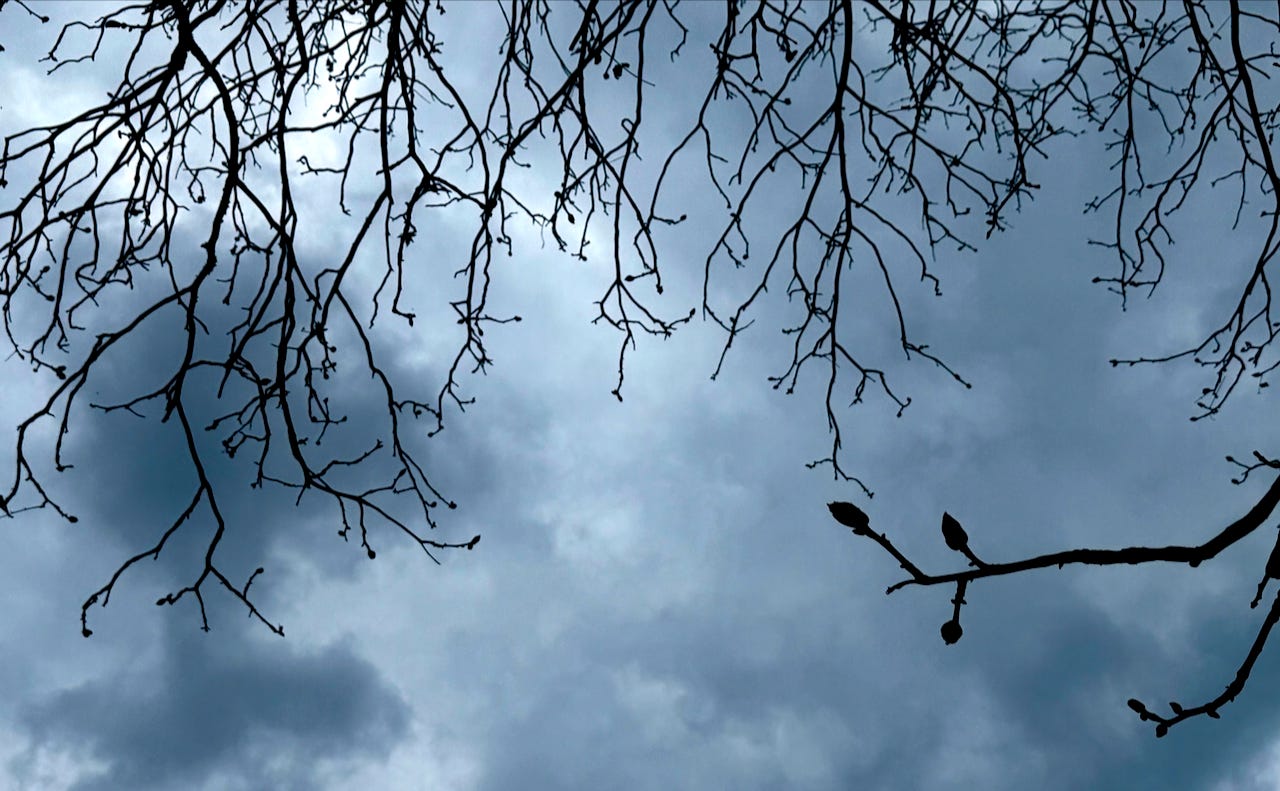
I settle deeper into the sheets, pulling the quilt up and under my chin, then over my face as an invisible ponderance presses on my chest, my head, my throbbing right knee. Even before first light reveals slate skies, before low rumbles quake the house, I feel the storm's density and imminence.
But while a spring thunderstorm registers as a palpable oppression, our perception is only half right. Yes, we can physically feel it, but the storm isn't bearing down on us with the force of atmospheres multiplied. I don't sense the storm because the air, weighted with water as it is, mashes down on me. What I'm feeling is the liquid within me being liberated. Just a little.
Dropping barometric pressure means there's less air mass pushing against our permeable forms, and this stirs the water in our bodies to test its boundaries. Our fluids flow with less encumbrance, our tissues thicken, joints and muscles swell, and organs expand as the borders of our mostly gelatinous components relax. It's a reminder that despite all the poetry and weapons of mass destruction and deities we've created, we're just bags of barely self-aware water. Sometimes this climactic reminder hurts, and sometimes it just feels like something is off. For me, this morning, it's both.
I roll and sit on the mattress edge, trying to summon motivation that finally arrives as a craving for coffee. I totter to the kitchen and notice the living room curtains are still. Dawn never breaks, but gray light seeps through the panes as the morning mires in liminality.
II.
A few weeks ago, I spoke to an environmental science class at my college alma mater. Every environmental writer goes into every one of these situations with the same virtuous notions—inform, offer informed opinions, and most of all, inspire hope. The class had done its homework, so to speak. They'd read my reporting on the disappearing marshes of South Louisiana and the degradation of Florida Bay. They knew I'd covered problems with industrial agriculture, from nutrient overload in waterways, to disenfranchised rural communities, to the system's inherent animal abuse.
They'd also read, or at least been assigned to read, a few of my more introspective essays. Based on their research into my work, they compiled a list of questions. Lots of questions about water—oppression of, liberation of, compromise with. Lots of questions about pressure—environmental, political, economic. It was a list of queries asked with the absolute sincerity of curious minds, but received with the jaded cynicism of a curmudgeon.
"Mr. Sain, what are the biggest threats to the Louisiana marshes and how do we mitigate them?"
You mean how do we manage flood control so people can live, work, and pollute in South Louisiana but still somehow save this incredibly rich ecosystem created by and totally dependent on seasonal flooding?
"What are the biggest threats to Florida Bay and how can we save the habitats there?"
You mean how do we wean ourselves off of sugar? How do we rid ourselves of an addiction to the same damn substance responsible for most illness in this country, a substance also largely responsible for the strangulation of a place near mythical in its wonders?
"Do you think there's any way we can responsibly, sustainably, and humanely farm livestock on the scale we need to feed everyone?"
You mean how can we deal with the literal tons of shit polluting our creeks and still enjoy a plate of good barbecue? How do we save local economies while systematically siphoning money and labor from them? How do we ensure everyone eats meat carved from creatures engineered to the point that they're no longer really pigs or chickens or turkeys, creatures who barely see the sun and never touch soft grass? How can we eat those beings guilt-free?
What can we do to address climate change?
You mean how do we continue to collect carbon locked away in the Earth and reintroduce it into a cycle that we've already disrupted beyond repair for the foreseeable future without toasting the planet even sooner? How do we continue main-lining fossil fuels—our junkie-civilization's drug, the one thing we need in order to continue to manipulate the world to our liking—and still keep this world? How do we reckon an economy built on the false premise of infinite growth with the reality of finite resources? How do we weigh the economic gain vs. environmental loss and survival of humanity in the long term and still say we give a damn about anything except money? How do we justify the dying of our most unfortunate in the short term? How have we reached the absolute pinnacle of absurdity that says human lives, the planet's livability, and natural systems we depend on are just goddamn options to consider?
I stifled my despondence and fielded those slow rollers with predictable replies—market-based policies, command and control regulations, grassroots efforts geared toward "sustainability" (whatever that means). No one wants to hear a message of doom and gloom, and certainly not one that might damage the morale of these young adults training for battles on the front lines of environmentalism.
But as the hackneyed words dribbled from my lips, sounding like the hollow promises of a mouthpiece to my ears, something inside me shifted. Something moved. It was as if a great ponderance were pressing into my chest, forcing me to pull the metaphorical covers up to my chin and over my head. But I resisted the impulse to hide.
A wave of nausea rolled through my gut, and I'm sure the students saw the revulsion on my face, heard it in my timbre, my body revolting, the physical manifestations of a man (for better or worse) incapable of seamless bullshitting. These questions have been asked ad nauseam. The solutions I've parroted have been promoted just as often. Meanwhile, the problems are metastasizing.
As Aldo Leopold said, the consequence of environmental knowledge is the damnation of clear vision. You will see, and understand in terrible detail, that we live in a world of horrible wounds.
I am cursed with sight.
III.
The class's naiveté was understandable. Hell, we're all caught up in the delusion. We just know that our human ingenuity will prevail. If we can just think it through, we'll figure out a way to have our cake and eat it, too. It's a coping mechanism.
Surely we can figure out a way to have our expansive Bermuda grass lawns and $10K zero-turn mowers and still save the native wildflowers. Why can't we enjoy a mosquito-free evening in the yard and have monarch butterflies, too? I'll bet there's a way we can keep sucking that Ogallala Aquifer—groundwater collected over thousands of years, the hydro-foundation of pretty much all Great Plains agriculture, several cities, and natural ecosystems—dry in less than a century and still expand those cities on top of it, still row crop corn to feed our swine, cattle, and cars. We can go on road trips across the country and fly across the globe and live in outsized abodes because we're composting the kitchen scraps and growing our own tomatoes (for a couple months) in the backyard. We can eat fish every day because they're caught in a "sustainable" (whatever that means) way—says so right on the label.
And none of these wants are considered extreme privilege. Most would be considered entitlements—what we deserve for being born where, when, and to whom we were.
For the industrialized world, our day-to-day existence hinges on the consumption of an obscene amount of energy. Besides those uses already mentioned, we've got heating and cooling, laundry, our myriad electronic devices and the digital universe our economies are tethered to, the clothes we wear, the water we drink, the books we read. These are just the basics for us, but even a "simple" life is an enormous drain. The average American consumes about 250,000 kilocalories of energy per day, though we only need 1,600–3,000 for biological survival. The other 240,000-plus is directed to coddling. For comparison, an elephant might consume 40–50,000 kilocalories per day. Energy is never free, but we rarely pause to consider how much we use and the cost beyond dollars and cents we pay individually. Those other costs, known as externalities, are shouldered by everyone and everything on Earth.
But even after being confronted with this information, surely, Johnny, we can have everything we desire and figure out a way to sidestep the consequences of our largely thoughtless consumption, right?
This supreme confidence/arrogance isn't a bug of our human nature; it's a feature. It's how we survived in the Rift Valley of East Africa as relatively small, clawless, fangless primates. It's how we ventured from there in every direction and supplanted the felids, canids, ursids, and even toothed cetaceans as THE supreme predator on the planet. But while we're clearly not angels, we're not demons either. What we are is ruthlessly efficient opportunists, survivalists without peer. We are animals unmatched in our adaptability and ingenuity because of evolution's haphazard serendipity.
No other single species of animal has ever held this level of manipulation over the planet. It's thanks to our thinking, our grasp of abstraction, and our talent for bringing those concepts into tangibility manifested by sheer force of will and imagination. And then we use these imaginings brought to material reality as justification for everything we do.
We’ve even crafted our own geological epoch. We call it the Anthropocene.
The storm has not passed. Another piece in this series coming soon.
Read twice. Good prophet talk!